Showing posts with label David Bossert. Show all posts

Sunday, October 13, 2013

Destino

Destino


While reading David Bossert’s book, Remembering Roy E. Disney I was reminded about a Disney movie I’d heard about but never watched, Destino.

When Dali came to America he wrote back to friends that he was excited to be in America and in contact with the three great American Surrealists, The Marx Brothers, Cecil B. DeMille and Walt Disney.


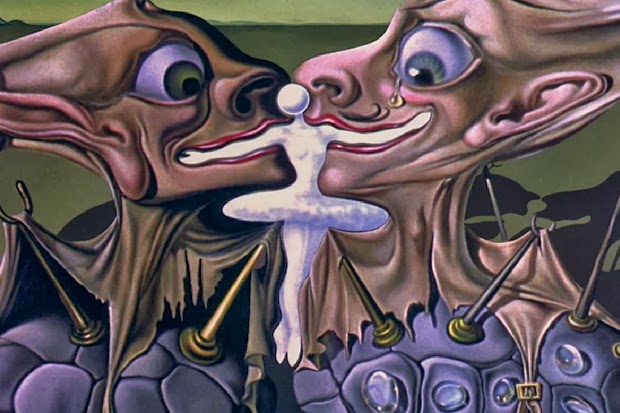
In 1945/6 Walt Disney asked Salvador Dali to collaborate with the Disney Studio to make an animated short. Dali was happy about the idea and for eight months worked with John Hench on making a short based on the song originally to be in The Three Caballeros, Destino (Destany).

Destino is a love story between Chronos (Time) and a human woman. Dali was at the studio every day 9-5 working with John Hench to make this cartoon but it was shelved after Dali told Disney he had yet another direction to take the story, adding Baseball as a metaphor for life. After eight months and tens of thousands of dollars Disney decided it was time to drop the project. By the time they stopped the project there were many pictures. Some were made by Dali and some by Hench. Hench became do adept at drawing in Dali’s style that at times Dali could not even tell who drew which picture. The 150+ Dali original and Dali inspired John Hench work was put into the “Disney Morgue” in 1946.


The “Disney Morgue” was the studio basement where all art and movie props were stored. This basement was were these items sat until the early 1970’s when Dave Smith was hired to create the Disney Archives. Dave said the original Disney Morgue was wet, sometimes flooded with rain water and had large signs saying “Beware of Spiders”.

In the 1990’s Roy E. Disney wanted to revisit an idea his Uncle Walt had back in the 1940’s, Fantasia. While working on it he remembered the Dali artwork in the Archives. Roy E. Disney became excited about the idea of completing this unfinished film. He talked to David Bossert about making and they worked together to bring it to completion.


John Hench was still working at the Disney Studio in his early 90’s when the Destino project was brought back to life. The new team working on Destino brought John Hench in and asked him about the original project. They set up the original storyboards and asked John Hench to help complete the story and return the story to the original direction. The idea was to complete as it was intended.

Disney had a studio in Paris at the time Destino came back into production. Dominique Monfery from the Disney Team in Paris was asked to direct Destino. He was even able to use notes written by Dali’s wife Gala. These notes show that Dali actually had about 40 different story lines for Destino.

Here is what WikiPedia says about Destino:

History[edit]
Destino (the Galician, Spanish, Portuguese and Italian word for "destiny") was storyboarded by Disney studio artist John Hench and artist Salvador Dalí for eight months in late 1945 and 1946; however production ceased not long after. The Walt Disney Company, then Walt Disney Studios, was plagued by many financial woes in the World War II era. Hench compiled a short animation test of about 17 seconds in the hopes of rekindling Disney's interest in the project, but the production was no longer deemed financially viable and put on indefinite hiatus.
In 1999, Walt Disney's nephew Roy E. Disney, while working on Fantasia 2000, unearthed the dormant project and decided to bring it back to life. Disney Studios France, the company's small Parisianproduction department, was brought on board to complete the project. The short was produced by Baker Bloodworth and directed by French animator Dominique Monfréy in his first directorial role. A team of approximately 25 animators deciphered Dalí and Hench's cryptic storyboards (with a little help from the journals of Dalí's wife Gala Dalí and guidance from Hench himself), and finished Destino's production. The end result is mostly traditional animation, including Hench's original footage, but it also contains some computer animation.
Description[edit]
The six-minute short follows the love story of Chronos and the ill-fated love he has for a mortal woman. The story continues as the woman dances through surreal scenery inspired by Dalí's paintings. There is no dialogue, but the soundtrack includes music by the Mexican composer Armando Dominguez. The 17 second original footage that is included in the finished product is the segment with the two tortoises (this original footage is referred to in Bette Midler's host sequence for The Steadfast Tin Soldier in Fantasia 2000, as an "idea that featured baseball as a metaphor for life").
Public screenings[edit]
Destino premiered on June 2, 2003 at the Annecy International Animated Film Festival in Annecy, France. The short film was very well received; it won many awards and was nominated for the 2003 Academy Award for Best Animated Short Film. Destino was released theatrically in a very limited release with the film Calendar Girls.
In 2005, the film was shown continuously as part of a major retrospective Dalí show at the Philadelphia Museum of Art, titled The Dalí renaissance: new perspectives on his life and art after 1940.[2]
The film was also shown as part of the exhibition Dalí & Film at Tate Modern from June to September 2007, as part of the Dalí exhibit at the Los Angeles County Museum of Art from October 2007 to January 2008; at an exhibition at New York's Museum of Modern Art called Dalí: Painting and Film from June to September 2008; also at an exhibit at the Dalí Museum in St. Petersburg, Florida in 2008. In mid-2009, it had exposure in Melbourne, Australia at the National Gallery of Victoria through the Dalí exhibition Liquid Desire, and from late 2009 through April 2010 at the Dayton Art Institute in Dayton, Ohio, in an exhibit entitled Dalí and Disney: The Art and Animation of Destino.
As of 2012, the film is featured in the "Dalí" exhibition at the Centre Georges Pompidou in Paris, France.
Home video release[edit]
The Disney DVD "True-Life Adventures, Volume 3" has a trailer for Destino, and mentions a forthcoming DVD release. In 2007, the True-Life Adventure series was suspended and those titles previously announced were moved to the Walt Disney Treasures line. Destino was subsequently scheduled for release on November 11, 2008.
From the January 20, 2008 press release:
Destino began in 1946 as a collaboration between Walt Disney and the famed surrealist painter Salvador Dalí. A first-hand example of Disney's interest in avant-garde and experimental work in animation, Destino was to be awash with Dalí's iconic melting clocks, marching ants and floating eyeballs. However, Destino was not completed at that time. In 2003, it was rediscovered by Walt's nephew, Roy E. Disney, who took on the challenge of bringing the creation of these two great artists to fruition. In addition to the completed Destino, this exciting addition to the Walt Disney Treasures line also includes an all-new feature-length documentary that examines the surprising partnership between Dalí and Disney plus two new featurettes; "The Disney That Almost Was", an examination of the studio's unfinished projects; and "Encounters with Walt", which addresses the surprisingly diverse group of celebrities and artists who were attracted to Walt Disney's early work.
A June 2008 press release for the Walt Disney Treasures line revealed Destino was being excluded from a 2008 Treasures release. According to Treasures host Leonard Maltin, the film was still likely to see an eventual DVD release, yet not necessarily within the Treasures moniker.
Destino was made available as a special feature on the Fantasia & Fantasia 2000 Special Edition Blu-ray released on November 30, 2010.[3]


Wednesday, October 9, 2013

The Haunting of the Disney Studio

The Haunting of the Disney Studio


In reading both David Bossert’s book, Remembering Roy E. Disney and Marty Sklar’s book Dream It! Do It! I found out some interesting things about the history of the Disney Studio. This was reinforced by some bonus features on the Blu-Ray of The Little Mermaid.

From shortly after Walt Disney’s death in 1966 to the early 1980’s was considered the dark ages for Disney Animation. Animated features were few and of lesser quality than when Walt was alive. The studio hit rock bottom with Black Caldron in 1985. The original 9 Old Men, team of animators had died, retired or was about to retire. New, young animators were taking over the studio. These young men were all excited to be in the Disney Studios working at the desks of legends in the field of animation. They also found themselves haunted by doubt. Could they live up to the likes of Frank and Ollie, Ward Kimble and the rest of the 9 Old Men and those they had mentored during the early years of the studio and beyond.

In the late 1980’s new management considered shutting down the Animation Studio in favor of putting the energy into live action films and the parks. Roy E. Disney stepped up fought for animation. The new management (Roy E. had helped bring them in) gave into Roy E. DISNEY and allowed animation to continue at Disney Studios but felt real estate at the Disney Studio in Burbank was at a premium so the Animators were moved into trailers on a lot in Glendale.

At first hearing about this and also hearing what the animators that worked there at that time said the general consensus was Disney management was wrong to move them. They moved the animators out of the building made for them into trailers! How disrespectful! How hard that must have been for those men! What I’ve learned recently reading the books I’ve mentioned and watching the bones feature that it started out bad but the move turned out for the best for the studio and them!

The animators had to fight for the respect they deserved. They had to fight for their art form. They had to show the studio heads that knew nothing of animation how valuable it was. But mostly they got away from the old Disney Animation Building were arguably the best of the best in animation had gone before them.

In the new trailers they were able to be themselves and work hard to show what they could do. Instead of looking at their desk and wondering what Frank, Ollie, Ward or Mark Davis might have done with what they were working on they were free to explore and see what they could do. They were free to try new things and Roy E. Disney was a bridge to the past that reminded them of where the studio came from and to encourage them to “Keep Moving Forward” as his Uncle Walt had said.


In 1995 Disney Animation returned to the Disney Studio Lots in Burbank and is now located in what is called the Roy E. Disney Animation Building.t

Friday, September 27, 2013

A Half Hour Chat with David Bossert

A Half Hour Chat with David Bossert


After reading and reviewing David Bossert’s book, Roy E. Disney: Memories and Photos of a Storied Life I had the distinct pleasure of a half hour phone call interview with him. I expected this to be a conference call with other Disney bloggers and Disney Fan sites on the line. I HOPED to get one question asked. Instead I was the only person on the call with David! When I found out I was to be the only one interviewing David at this time I was surprised and yes a little nervous.


Here is what I came away with from my half hour chat with David Bossert.

PP:       Thank you David for sharing your Memories and Photos of Roy E. Disney.
David:  You’re welcome. People are telling me it is an easy read.

PP:       How did you get involved with Disney?
David:  While still going to Massapeque High School I knew I wanted to be involved in art. After I graduated High School I went to a local art collage. Then I heard about CalArts in Valencia and the Animation program there started by Walt Disney. I applied for a Disney Scholarship and received it. After graduating I worked at a small animation studio doing special effects for 8 months. Then a friend of mine called me and said the Disney Studio was looking for special effects animators. So I applied and started working on the Black Caldron on special effects.

PP:       Why do you feel it is so important to write a book about Roy E Disney?
David:  Nothing had been written about Roy E. Disney and how he saved the company. I was talking to my friend, Don Hanh about the lack of a book about Roy E. and he encouraged me to write the book. I call myself an accidental author. I never planned on writing a book. Now I have several other books in the works.
            I also wanted to give back to Roy E. As stated in my book I had a Disney Scholarship and from the first time I met Roy I did my best to pay back. I felt I owed it to him and the Disney family.

PP:       What was the most interesting project you worked on with Roy E?
David:  “Destino” was the most interesting project. (Destino was started by Walt Disney and Salvador Dali in 1945.) John Hench originally worked on the project. John Hench was in his 90’s and he came in and helped us to complete the film the way it was originally intended to be made. It was nominated for an Oscar and I got to go to the Oscar’s with Roy E. Disney.

PP:       You mentioned in your book that you and Roy E. shared a love of sailing. What made that topic so special to both of you?
David:  As I said in the book I’m a day sailor. I enjoy being out on a sail boat for a day in calm seas. Roy on the other hand loved to race. He loved to be in strong winds and being keeled over. He could share his enjoyment of sailing with me because I understood the language. I knew what he meant when he said he tacked or that he put up a particular sail. We understood each other when we talked about sailing where other people did not understand the language.

PP:       I noticed when I read the book you handled privet matters in a sensitive manor. You gave just enough to let the reader know there was a problem but never went into details. Thank you!
David:  We all have things that are privet. Some of the family was concerned about how I would cover things like the divide be Walt and Roy O.’s families and Roy E.’s divorce and second marriage. Some things are nobody’s business and I wished to respect Roy E. and the entire Disney Family. As stated in my book Diane Miller Disney and Roy E. did start communicating and things healed some.

Thank you David Bossert for taking the time to talk to me. Your kindness is greatly appreciated. I wish to thank Laura at Disney PR for getting the book to me to review and setting up this interview.

Again I say get the book Roy E. Disney: Memories and Photos of a Storied Life by David. It is an AMAZING read. It is an easy read and is more like a scrapbook with extensive captions to the photos. Sometimes the words paint the picture for you.


David asked me to say that if you read his book please review it. Let people know how you like it.

If you would like to read my review of David's book, "Remembering Roy E. Disney: Memories and Photos of a Storied Life" click the link below:


My Christmas book, “An Angel Remembers 25 Voices of Christmas” is available!!
This is a collection of 26 short Christmas stories that together bring the amazing events of Christ’s birth alive. It is my hope that this will help encourage families to spend 10-15 minutes a day together during the busy holiday season remembering the true reason for the season.
You can find it for ALL eReader formats and PDF at:

For your Nook the link is:

It is also available at the iTunes book store and many other ebook seller sites.
The only big site not carrying my book is Amazon.
You can download a Kindle version from Smashwords.com